

Sections in this Article
Intro & Some Background
In this legal thriller based on the John Grisham novel, a high-profile “products liability” lawsuit against a gun manufacturer is the backdrop for an intricate game of jury manipulation. The movie opens with a happy family celebration followed by a workplace shooting during which stockbroker Jacob Wood (Dylan McDermott) is killed. The plaintiff in the civil lawsuit is his widow, Celeste (Joanna Going).
If you want to avoid the depictions of violence, you can safely skip ahead. These opening scenes are unnecessary to the rest of the film except to evoke the viewers’ emotions and humanize the context.
In the 1996 novel, The Runaway Jury, the product is tobacco, and the character Jacob Wood dies of lung cancer. The novel was timely. People had been losing their individual lawsuits against tobacco companies, so, beginning in the mid-1990s, many states initiated their own lawsuits against the tobacco industry under various consumer-protection and antitrust laws. These state lawsuits were succeeding where the individual lawsuits were not. The culmination was the 1998 Tobacco Master Settlement Agreement. You can read more about that here and here.
The movie, The Insider, tells the related story of a big tobacco whistleblower. Because The Insider was released in 1999, the decision was made to change the litigation subject in the Runaway Jury adaptation, released in 2003, from tobacco to guns.
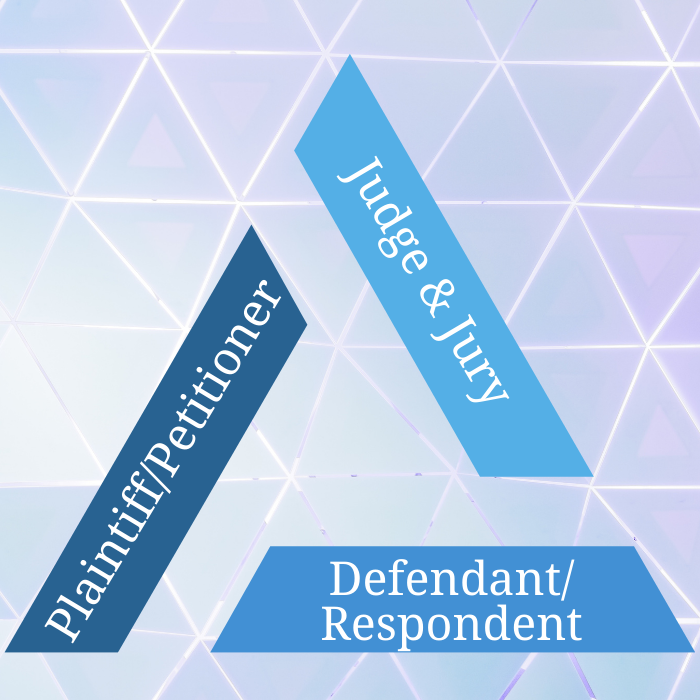
I often talk with pro se folks about the dynamics of the plaintiff/petitioner – defendant/respondent – judge (and sometimes jury) triad. While that triangle certainly is present in Runaway Jury, it is subordinated to the dynamics of the plaintiff’s jury consultant – defendant’s jury consultant – juror triad.

Jury Consultants
The drama unfolds through an elaborate con orchestrated by Nick Easter (John Cusack), a seemingly ordinary juror, and his partner Marlee (Rachel Weisz), who operates from outside the courthouse. Their scheme involves gaining control of the jury’s decision-making process, but their true motivations remain hidden until the end. They play both sides—accepting money from the gun lobby while secretly working toward their own agenda.
Jury consultants are professionals hired by attorneys to help select favorable jurors and develop trial strategies based on psychological and demographic analyses. They research potential jurors’ backgrounds, social media profiles, and public records to identify biases, political leanings, and life experiences that might influence how someone would view a case. During jury selection, consultants advise lawyers on which questions to ask and which prospective jurors to challenge or accept based on their likely sympathies toward the client’s position.
Jury consultants also conduct mock trials with focus groups to test how different arguments and evidence might resonate with typical jurors, helping attorneys refine their presentation strategy. They analyze body language and reactions during actual jury selection and sometimes throughout the trial, providing real-time advice on adjusting tactics.
Jury consultants are expensive, so it makes sense that Grisham dove into this subject in the context of first big tobacco then the gun industry.
The film does a great job portraying jury selection as a science, with both sides employing jury consultants who analyze potential jurors’ backgrounds, body language, and psychological profiles. Rankin Fitch (Gene Hackman), the ruthless, manipulative consultant hired by the defense, represents the dark side of this process, using intimidation and surveillance tactics that cross ethical and legal boundaries. At one point in the movie he says, “Trials are too important to be left up to juries.”
The plaintiff’s attorney, Wendell Rohr (Dustin Hoffman), and trial consultant, Lawrence Green (Jeremy Piven), are portrayed as kinder, more personable, more ethical and trustworthy, and of course more resource-limited. This is an expected if not overly simplified good guys – bad guys contrast. But the “good guys” are not perfect and have their own shades-of-grey moments.
In one scene, Green tells Rohr he has mustard drips on his tie. Rohr responds, “I did that on purpose,” proving litigation is largely performative and even attorneys with limited budgets can employ subtle manipulations that have nothing to do with the elements of a cause of action.
The courtroom scenes balance legal procedure (imperfectly portrayed) with human drama, showing how attorneys must adapt their strategies based on jury reactions and unexpected developments. The plaintiff’s challenge isn’t just proving the case legally, but overcoming a defense team with virtually unlimited resources and questionable methods.
“Products Liability”
Products liability is a legal theory that holds manufacturers, distributors, and sellers responsible for injuries caused by defective products, regardless of whether these manufacturers, distributors, and sellers acted negligently. This doctrine evolved from traditional contract and negligence law to provide better protection for consumers who were often unable to prove fault against large corporations.
Historical Development: Products liability law was first formally codified in Section 402A of the Restatement (Second) of Torts (a “secondary” legal research resource), published in 1965. This provision established “strict liability” for defective products. “Strict liability” torts hold defendants liable for damages or injuries even in the absence of negligence or any level of intention. The products liability doctrine was so consequential that the growing body of law eventually led to a new, dedicated Restatement of Torts, Third: Products Liability, which was published in 1997. So perhaps it was the dynamism of this period in our legal history that inspired Grisham to pen The Runaway Jury.
Essential Elements: To succeed in a products liability claim, a plaintiff must typically prove three core elements:
1. The defendant was in the business of selling the product – This means the defendant must be a commercial seller, not a casual seller like someone having a garage sale.
2. The product was defective and unreasonably dangerous – The plaintiff in a product liability case must prove that the product that caused injury was defective and that the defect made the product “unreasonably dangerous.” There are three types of defects:
- Manufacturing defects: The product wasn’t made according to its intended design
- Design defects: The product’s design itself is inherently dangerous
- Warning/instruction defects: Inadequate warnings about known dangers or insufficient instructions for safe use
3. The defect caused the plaintiff’s injury – There must be a direct causal connection between the product defect and the harm suffered.
Final Notes
I recommend Runaway Jury as an entertaining movie and a thoughtful examination of how money and manipulation can corrupt the legal system. I streamed the movie for free on Plex.
Copyright © 2025 by Sherri L. Renner, J.D. | All rights reserved
About the Author
Sherri Renner, J.D., is the founder of LawYou America. She fully dedicates her education and years of litigation experience to helping the self-represented.


